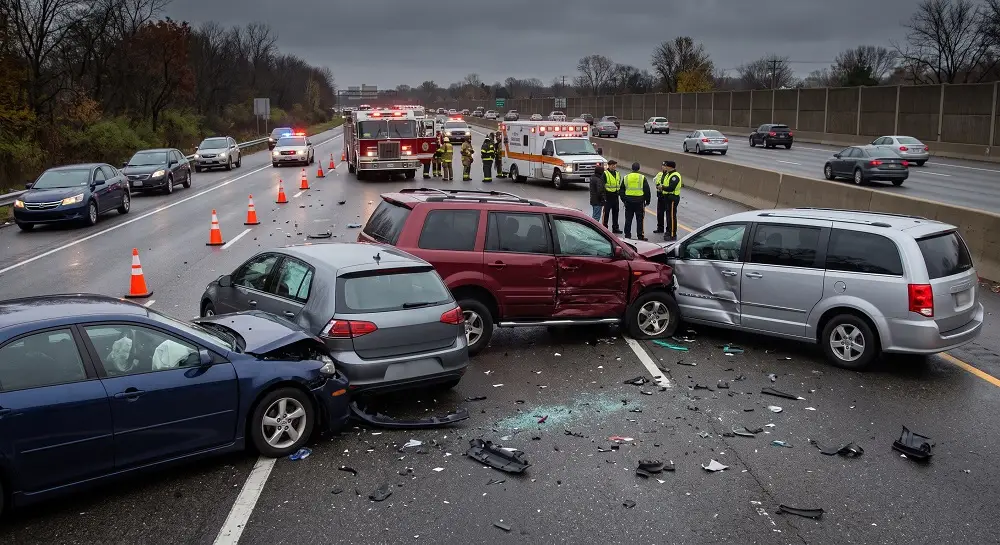
A Massachusetts primary seat belt law would let police stop a driver for a missing belt alone, but that is not the rule yet: today, seat belt enforcement in Massachusetts is secondary only. Police may write a seat belt ticket only after stopping a driver for another reason, such as a motor vehicle violation. In the 2025–2026 session, legislators filed House Bill 2688 (HB 2688) and Senate Bill S.1699 to make belt enforcement primary. Both bills were sent for study, and there is no primary law.
If you were hurt in a crash, a Boston car accident lawyer can explain how your claim works, whatever the belt rule is.
What Is the Difference Between Primary and Secondary Seat Belt Enforcement?
Under secondary enforcement, an officer cannot pull you over for an unbuckled belt alone. The belt citation can only come after a stop for a different motor vehicle offense. Under primary enforcement, a missing belt is reason enough for the stop.
How the Rule Works in Massachusetts Today
The Commonwealth's own guidance says the current law is subject to secondary enforcement: police may enforce a seat belt violation only if the operator has been stopped for another motor vehicle law or offense (Mass.gov car seat laws). A driver going the speed limit, signaling, and staying in lane cannot be stopped simply because an officer sees no belt.
A primary law would change the order of events. An officer who sees a driver without a belt could make the stop for that reason alone and issue the ticket, with no other violation needed.
What Has to Happen Before Anything Changes
A bill changes nothing on the road until it is enacted. Even then, HB 2688 and S.1699 would not take effect until 180 days later. HB 2688 was filed in the 2025–2026 session to establish a primary seat belt law in the Commonwealth. It was sent to study order H5254 on March 19, 2026. The Senate bill, S.1699, has the same aim; malegislature.gov shows it was sent to study order S2798 on December 4, 2025. Until a bill is enacted, the secondary rule remains the law.
The idea is not new. In the 2023–2024 session, the same sponsors filed similar bills: S.1521 (the earlier version of S.1699) and H.2395 (the earlier version of H.2688).
For who must buckle up and the rules that apply today, read our guide to Massachusetts seat belt laws.
How Would the Rules Change if the Bill Passes?
If a bill like this passes, police could stop a driver for not wearing a seat belt even when nothing else is wrong.
| Question | Today | Under HB 2688 and S.1699 as proposed |
|---|---|---|
| Can police stop you for no belt alone? | No | Yes |
| When can a belt ticket be issued? | Only after a stop for another motor vehicle offense | During a stop made for the belt violation itself |
| Fine | $25 under Chapter 90 § 13A | S.1699 proposes $50 for people 16 and older, with fines going to the Head Injury Treatment Services Trust Fund (text of S.1699) |
| Status | Current law | No primary law. HB 2688: sent to study order H5254 on March 19, 2026. S.1699: sent to study order S2798 on December 4, 2025 |
| Searches and insurance | No insurance surcharge | No insurance surcharge; police may not search a vehicle or its occupants solely because of a belt violation |
The "today" column reflects the state's description of secondary enforcement. The proposed column reflects what a primary law means, and would apply only once a bill is enacted.
Hurt in a Massachusetts Crash?
Whatever the seat belt rule says, an injury caused by another driver may give you a claim. The Law Office of John J. Sheehan offers a free consultation in English or Spanish.

What Do Supporters of a Primary Seat Belt Law Argue?
The state tracks both belt use and crash deaths. The Executive Office of Public Safety and Security (EOPSS), which oversees highway safety, reported a record-high seat belt usage rate of 85.53% for Massachusetts in 2025, up from 84.36% in 2024 and the third straight annual increase. The 2023 study put the rate at 80.4%.
Supporters of primary enforcement argue that a record is not the same as full compliance. In their view, letting officers stop drivers for the belt alone would push usage higher still, because the belt would no longer depend on a separate violation to be enforced.
How Would a Primary Seat Belt Law Affect Injury Claims and Case Value?

Two Massachusetts statutes frame the question. G.L. c. 90 § 13A is the seat belt statute, and it makes belt enforcement secondary today. A belt violation under it is not treated as a moving violation for insurance surcharges, and the statute is silent on civil lawsuits. A bill like HB 2688 or S.1699 would change who can be stopped for a belt violation. Neither statute answers directly how an unbuckled belt affects case value.
Massachusetts is a comparative negligence state. Failing to buckle up won’t prohibit you from filing a claim against a negligent driver, but an insurance company may cite your failure to wear a seat belt as a factor in your injuries. How much that matters depends on the facts of the crash, which is why it helps to talk with a lawyer.
Get Help After a Crash
Whatever happens in the Legislature, people hurt in Massachusetts crashes may have an injury claim. Learn more about our law office, with offices in Boston and Wakefield serving the Greater Boston Area in English or Spanish, or contact the office for a free consultation.
Questions People Ask About the Massachusetts Seat Belt Bill
-
No. The state describes the current law as secondary enforcement, so a belt ticket requires a stop for another offense first. HB 2688 and S.1699 would change that, but there is no primary enforcement law: S.1699 was sent to study order S2798 on December 4, 2025, and HB 2688 to study order H5254 on March 19, 2026.
-
They are bills introduced in the 2025–2026 session of the Massachusetts Legislature, aimed at establishing a primary seat belt law in the Commonwealth. They would let police enforce the belt requirement on their own.
-
The Executive Office of Public Safety and Security publishes a seat belt usage study. Its 2025 report put the statewide rate at a record-high 85.53%, up from 84.36% in 2024.
-
Yes. According to MassDOT figures released in January 2026, fatal motor vehicle crashes fell from 364 in 2024 to 342 in 2025.

John J. Sheehan
Managing Attorney
Attorney Sheehan is fluent in Spanish and is privileged to represent many clients from the Latin American community in the Greater Boston area.
Talk to a Massachusetts Car Accident Lawyer
Hurt in a crash? The Law Office of John J. Sheehan can review your case and explain your options.