Workplace Eye Injury? Massachusetts Law Is on Your Side.
Losing your sight, even partially, can turn your entire world upside down. If you suffered vision loss in a workplace accident, you have rights under the Massachusetts workers' compensation law and may be entitled to far more than a standard workers’ comp claim provides.
Attorney John J. Sheehan has been fighting for injured workers throughout Massachusetts since 1993. He knows how insurance companies handle these claims and how to push back when they try to minimize what you're owed.
Types of Workplace Vision Loss We Handle
Serious eye injuries take many different forms. Our vision loss injury lawyers handle cases involving:
- Partial vision loss: Reduced visual acuity in one or both eyes that limits your ability to work or perform daily tasks.
- Total loss of vision in one eye: Complete loss of sight in one eye due to a traumatic workplace accident or occupational disease.
- Total loss of vision in both eyes: Complete blindness affecting both eyes, which qualifies for permanent total disability benefits and significant specific injury compensation.
- Traumatic eye injuries: Punctures, lacerations, or blunt-force injuries that damage the eye's internal structures.
- Chemical burns: Caustic substance exposure that destroys corneal tissue and can cause irreversible blindness.
- UV radiation damage: Prolonged or unprotected exposure to ultraviolet light, welding arcs, or industrial lasers that permanently damages retinal cells.
- Foreign object injuries: Flying particles, metal shards, or debris that penetrate the eye and cause lasting harm.
- Degloving and socket injuries: Severe trauma to the eye socket, orbital bones, or surrounding tissue.
No matter how your eye injury happened, if it occurred on the job or due to a work-related condition, you may be entitled to full workers' compensation benefits under Massachusetts law.
Common Causes of Workplace Eye Injuries

Serious eye hazards are present in workplaces across Greater Boston every day. Construction sites, factories, warehouses, laboratories, and industrial facilities all expose workers to conditions that can cause permanent vision loss in an instant.
The following are some of the most frequent causes of workplace vision loss we see in our cases:
- Flying particles and debris: Workers in construction, manufacturing, and carpentry face constant exposure to metal shards, wood chips, and other airborne particles. Without proper machine guarding and eye protection, these particles can cause devastating eye injuries.
- Chemical exposure: Caustic chemicals, including industrial cleaners, solvents, acids, and bases, can splash into workers' eyes, causing severe corneal burns and permanent blindness. Many jobs in Greater Boston expose workers to these substances daily.
- UV radiation: Welders, glassworkers, and industrial equipment operators who work with open-arc equipment or high-intensity light sources risk permanent retinal damage from UV radiation exposure.
- Tool and equipment accidents: Power tools, nail guns, and heavy industrial equipment can cause catastrophic eye injuries when they malfunction, are improperly guarded, or are used in unsafe conditions.
- Struck-by incidents: Falling objects, swinging loads, and unsecured materials on construction sites frequently cause serious eye trauma.
- Loud noises and pressure: Explosive events, sudden pressure changes, and industrial blasts can cause retinal detachment and vision damage even without direct contact with the eye.
- Workplace vehicle accidents: Forklift and vehicle collisions can cause severe facial trauma, including eye socket fractures and injuries that lead to vision loss.
Workers in many industries face an elevated risk of eye injury, including construction workers, warehouse employees, factory workers, industrial equipment operators, healthcare workers, and laboratory technicians. If your job put you in contact with any of these hazards and you suffered vision loss, you may have a valid workers' compensation claim.
Your Benefits Under Massachusetts Workers' Compensation Law
Massachusetts workers' compensation law provides two distinct categories of benefits for workers who suffer vision loss: ongoing wage replacement and medical benefits, on the one hand, and specific injury benefits, on the other. Both can be pursued simultaneously, and together they can represent substantial compensation for your losses.
Ongoing Workers' Compensation Benefits
After a serious eye injury, Massachusetts workers' compensation covers the following:
- Medical benefits: Your employer's workers' compensation insurance must cover all reasonable and necessary medical treatment related to your eye injury, with no cap on the amount or duration. This includes emergency care, surgeries, specialist visits, rehabilitation, and prescription eyewear or adaptive devices.
- Temporary total disability (TTD) benefits: If you are completely unable to work while recovering, you are entitled to 60% of your average weekly wage, up to the state maximum, for up to three years. These benefits replace lost wages during your recovery.
- Partial disability benefits: If you can return to some form of work but at reduced capacity due to your vision loss, you may be entitled to partial disability benefits equal to 60% of the difference between your pre-injury average weekly wage and your post-injury earning capacity.
- Permanent total disability benefits: If your vision loss permanently prevents you from returning to any gainful employment, you may be entitled to ongoing total disability benefits for the rest of your life, including annual cost-of-living adjustments.
Specific Loss Injury Benefits for Eye and Vision Loss
Massachusetts law also provides additional one-time compensation for the loss of specific body parts and bodily functions, including vision. Under Massachusetts General Laws Chapter 152, Section 36, injured workers may receive specific injury benefits calculated as a multiple of the state average weekly wage (SAWW) at the time of the injury:
These specific injury benefits are paid as a lump sum in addition to, not instead of, your standard workers' compensation benefits for lost wages and medical care. This means a worker who suffers total loss of vision in one eye is entitled to receive both ongoing weekly benefits and a significant one-time specific injury payment.
Importantly, these benefits are available to all injured workers in Massachusetts regardless of immigration status. Undocumented workers have the same rights to workers' compensation benefits, and no inquiry into your documentation status is permitted during the claims process.
Don't Wait — Your Claim Has Deadlines
Schedule a free consultation with a Boston vision loss workers' comp attorney today.

Warning Signs of a Serious Eye Injury
Not all serious workplace eye injuries are immediately obvious. Some conditions that eventually lead to permanent vision loss begin with subtle symptoms that workers are tempted to dismiss. You should seek immediate medical treatment if you experience:
- Pain or pressure in one or both eyes after a workplace accident
- Blurred, double, or otherwise distorted vision
- Sensitivity to light that wasn't present before the incident
- One eye that doesn't move or track in sync with the other
- The sensation of something lodged in the eye that won't flush out
- Redness, swelling, or unusual discharge from the eye
- Any sudden change in the clarity or field of your vision
Promptly notifying your employer is essential to preserving your right to receive workers' compensation benefits. Do not wait to see if the symptoms resolve on their own. Delayed treatment can make your injury worse and complicate your workers' compensation claim.
Who Is Responsible When a Worker Suffers Vision Loss
Your employer's workers' compensation insurance is the starting point for your claim. But in many workplace eye injury cases, additional responsible parties may exist whose negligence contributed to your injury. Identifying all liable parties is critical to maximizing your compensation.
Employers have a legal duty to provide a safe workplace, including supplying appropriate personal protective equipment (PPE), enforcing safety protocols, and ensuring that all equipment is properly guarded. When employers cut corners, failing to provide safety glasses, ignoring OSHA regulations, or rushing workers through dangerous tasks, they bear responsibility for the eye injuries that result.
Common employer failures include:
- Failing to provide or require appropriate eye protection
- Inadequate machine guarding at points of operation
- No training on hazardous chemical handling
- Ignoring known hazards reported by employees
An experienced workers' compensation attorney can review the circumstances of your accident and determine whether OSHA violations or other employer failures contributed to your injury.
If defective equipment, a malfunctioning safety guard, or an inadequately labeled chemical contributed to your eye injury, the manufacturer may face strict liability under Massachusetts law. You don't need to prove the manufacturer was careless, only that the product was defective when it left the factory. Cases involving toxic chemical exposure or defective machinery guarding are among the most common third-party claims we see alongside vision loss workers' compensation cases.
On construction sites and industrial properties, general contractors and property owners have a duty to maintain safe conditions for all workers present. When they fail to enforce safety rules, allow hazardous conditions to persist, or fail to coordinate work among multiple trades, they may be liable for eye injuries that occur on their properties. If your vision loss happened on a construction site, you may have claims against multiple parties beyond your direct employer.
Pursuing third-party claims against manufacturers, contractors, or property owners can provide compensation beyond workers' compensation limits, including full lost wages, pain and suffering, and additional compensation for loss of a major bodily function.
Steps to Take After a Workplace Eye Injury
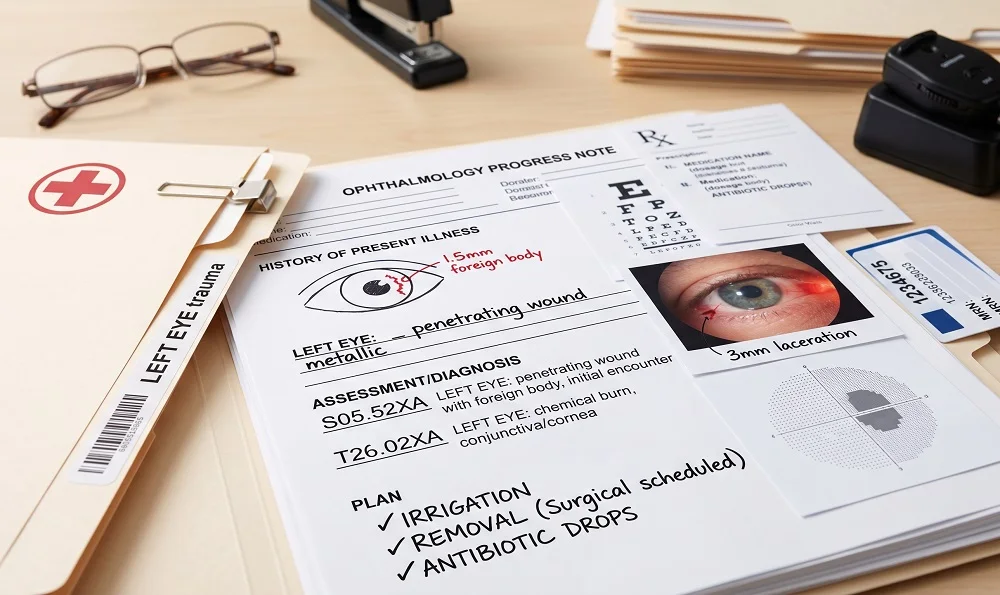
The actions you take in the hours and days after a workplace eye injury can have a direct impact on your ability to receive workers' compensation benefits and pursue any additional claims. A clear, deliberate response from the start protects both your health and your legal rights.
- Seek medical treatment immediately: Get emergency care as soon as possible to protect your health and create an official medical record of your injury, its cause, and its severity.
- Report the injury to your employer in writing: Notify your employer right away and put it in writing. Delayed reporting gives insurance companies grounds to dispute your claim.
- Document everything: Photograph the accident scene and equipment involved. Note the names of any coworkers who witnessed the incident.
- Preserve all medical records: Keep copies of every diagnosis, treatment plan, prescription, and specialist referral related to your eye injury.
- Avoid recorded statements to the insurance company: The insurer may contact you quickly. Do not give a recorded statement before speaking with an attorney.
- Contact a vision loss workers' compensation attorney: The sooner you have legal assistance, the better protected your rights will be. An attorney can manage the claims process, identify all liable parties, and ensure no deadlines are missed.
Each of these steps matters. The Law Office of John J. Sheehan is available for a free initial consultation to help you understand exactly where you stand.
Don't Face the Insurance Company Alone
Attorney John J. Sheehan has represented injured workers throughout Massachusetts since 1993. There is no fee unless we win.