boston bridge
Boston Personal Injury Lawyer

Boston Pedestrian Accident Lawyer

Hit in a Crosswalk or on a Sidewalk? We Can Help.

Wins for Our Clients

$1.5 Million

Construction Site Accident

Steel I-beam accident on a construction site, resulting in TBI and thoracic spine fracture, fractured ribs

Steel I-Beam fell from wood framing and fell on welder who suffered a traumatic brain injury (TBI), thoracic spine compression fracture, fractured clavicle, fractured ribs and crushed foot/ankle. Following extensive litigation with the general contractor, subcontractors and suppliers to the job site, case settled at mediation.

$800,000

Trip and Fall at Work

A wire loop hazard on a demolished construction floor caused a trip & fall with a right patella fracture and neck injury

Employee was caused to trip and fall at work on construction site. While walking across demolished floor of building being renovated, employee was caused to trip on a wire loop that was protruding from the demolished concrete floor. Employee was caused to fall forward landing on his knees. Employee sustained multiple injuries including a right patella fracture and neck injury. Eventually, Employee right patellofemoral replacement surgery. MRI of the cervical spine confirmed foraminal narrowing of C5-6 and C6-7 with possible compression of the C6 and C7 nerve roots. Employee filed a lawsuit to pursue third-party personal injury claims against the general contractor, demolition subcontractor and site subcontractor for the construction site where his accident occurred. The workers’ comp claim settled for $350,000 with liability accepted for future medical treatment. The third-party claim settled at mediation with all defendants for $450,000. In addition to the workers’ comp and third-party claims, Employee successfully filed for SSDI benefits.

$700,000

Construction Fall From Ladder

Ladder fall at work, resulting in a fractured and dislocated ankle with talus displacement

Employee was working as a master carpenter when he fell from a ladder and sustained multiple injuries including fractured and dislocated ankle with displacement of the talus. Employee underwent multiple surgeries to treat the ankle fracture including open reduction with internal fixation and hardware removal. Employee developed an infection of the ankle requiring multiple surgeries including skin graft surgeries. Employee developed Complex Regional Pain Syndrome (“CRPS”) of the lower extremity. Employee underwent Spinal Cord Stimulator surgery for chronic pain management related to the CRPS. Workers Comp claim settled prior to a Conference on Employee’s claim for §34A Permanent and Total Incapacity Benefits.

$656,000

Slip and Fall at Construction Site

Carpenter foreman slipped on ice at a construction site, causing an L4–5 herniated disc requiring surgery

Carpenter foreman slipped and fell on ice at construction site. Client injured his lower back and suffered a herniated disc at L4-5 with impingement requiring surgery. Settled workers’ comp claim for $200,000 and third-party claim against general contractor for $456,000.

$625,000

Pedestrian Hit By Car

Pedestrian pinned under a truck, suffering displaced compound tibia/fibula fractures

Pedestrian was standing by his uncle’s landscaping truck that was parked on the side of the road when a car hit the back of the truck and hit the pedestrian pinning him under the landscaping truck. Pedestrian sustained multiple severe and permanent injuries including displaced compound fractures to the tibia and fibula, clavicle fracture and multiple abrasions and contusion. Pedestrian underwent multiple surgeries to repair the fractures and skin grafting. Case settled prior to filing suit.

More Results
$800,000
Trip and Fall at Work

Employee was caused to trip and fall at work on construction site. While walking across demolished floor of building being renovated, employee was caused to trip on a wire loop that was protruding from the demolished concrete floor. Employee was caused to fall forward landing on his knees. Employee sustained multiple injuries including a right patella fracture and neck injury. Eventually, Employee right patellofemoral replacement surgery. MRI of the cervical spine confirmed foraminal narrowing of C5-6 and C6-7 with possible compression of the C6 and C7 nerve roots. Employee filed a lawsuit to pursue third-party personal injury claims against the general contractor, demolition subcontractor and site subcontractor for the construction site where his accident occurred. The workers’ comp claim settled for $350,000 with liability accepted for future medical treatment. The third-party claim settled at mediation with all defendants for $450,000. In addition to the workers’ comp and third-party claims, Employee successfully filed for SSDI benefits.

Table of Contents

    Types of Pedestrian Injury Claims We Accept in Boston

    The Law Office of John J. Sheehan handles pedestrian injury cases involving:

    • Drivers who fail to stop for people in marked crosswalks;
    • Turning vehicles that hit pedestrians at intersections;
    • Cars, trucks, or delivery vans that jump curbs or enter sidewalks;
    • Drivers backing out of parking spaces, driveways, alleys, or loading zones;
    • School zone and bus stop pedestrian crashes;
    • Parking lot pedestrian accidents;
    • Hit-and-run pedestrian accidents;
    • Uninsured or underinsured drivers;
    • Delivery vehicle, rideshare, taxi, bus, and company vehicle crashes;
    • Claims where the insurance company blames the pedestrian for crossing outside a crosswalk or against a signal.

    Pedestrian cases often turn on small details: the traffic light sequence, the crosswalk location, whether the driver was turning, whether another vehicle was stopped, how fast the driver was moving, and whether cameras captured the crash.

    Why Boston Pedestrian Accidents Are Different

    Boston's layout (narrow streets, heavy foot traffic, and constant construction) elevates risk. Even if a driver claims they didn't see you, they are legally obligated to maintain a lookout, yield, and control their speed.

    Boston’s Vision Zero resources track crash patterns and dangerous locations across the city. Those records can help show why a certain intersection, crossing, or corridor is known for pedestrian danger.

    National crash data also shows the seriousness of pedestrian injuries. The Governors Highway Safety Association reported that drivers struck and killed 7,148 pedestrians in the United States in 2024.

    Massachusetts Pedestrian Right-of-Way Law

    Massachusetts law gives pedestrians protection in marked crosswalks. Under M.G.L. c. 89, § 11, when traffic signals are not in place or not working, a driver must yield to a pedestrian in a marked crosswalk if the pedestrian is on the same half of the road as the vehicle or within 10 feet of that half. The law also prohibits a driver from passing another vehicle that has stopped at a crosswalk for a pedestrian.

    This law often matters when a pedestrian is hit because a driver:

    • Rolled through a crosswalk
    • Turned into a person who was already crossing
    • Passed a stopped vehicle near a crosswalk
    • Drove too fast for the area
    • Focused on traffic instead of checking for people on foot

    A crosswalk helps your case, but it does not prove everything by itself. Photos, video, witness names, the police report, medical records, and the driver’s statements can all affect the outcome.

    Who May Be Responsible for a Pedestrian Accident
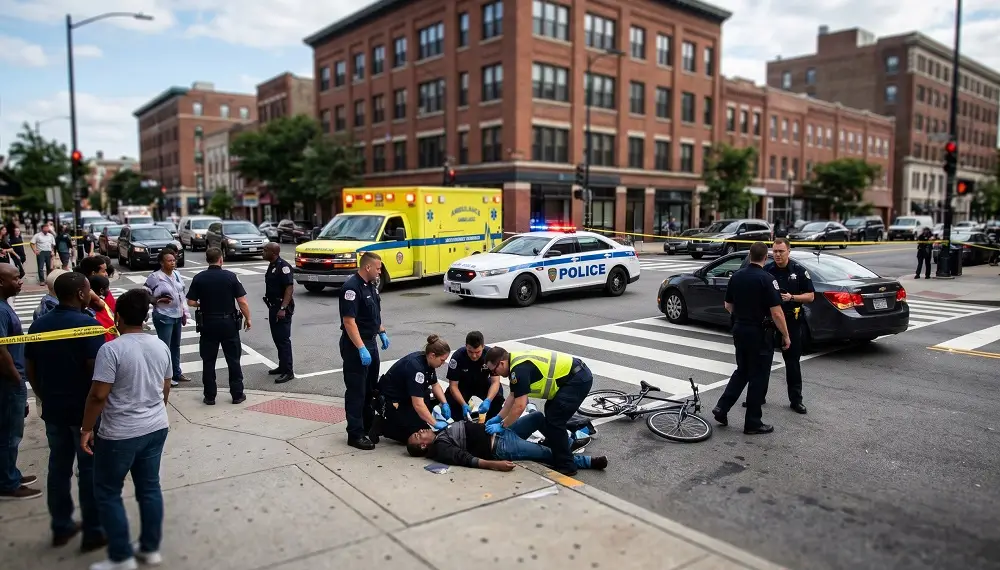
    Most claims start with the driver who hit the pedestrian. Depending on the facts, other parties may also be responsible.

    • The driver may be liable for speeding, distracted driving, failing to yield, unsafe turning, impaired driving, or backing up without checking for pedestrians.
    • An employer may be responsible if the driver was working at the time of the crash, such as a delivery driver, company vehicle driver, rideshare driver, taxi driver, contractor, or service worker.
    • A vehicle owner or commercial company may be part of the claim if a business vehicle, delivery van, truck, or fleet vehicle caused the crash.
    • A public entity or transit operator may be involved if the crash involved an MBTA vehicle, city vehicle, state vehicle, or a dangerous public property condition. These claims may have special notice rules and shorter deadlines.

    A pedestrian accident attorney in Boston can identify available insurance coverage and the parties who should be included in the claim.

    Common Injuries After a Pedestrian Accident

    Pedestrian crashes often cause serious injuries because the person walking absorbs the full force of the vehicle and the full force of striking the hard ground. Common injuries include:

    • Concussions and traumatic brain injuries
    • Broken bones and fractures
    • Hip, pelvis, knee, ankle, and foot injuries
    • Back, neck, and spinal injuries
    • Internal bleeding or organ damage
    • Shoulder, wrist, and hand injuries from the fall
    • Cuts, scarring, and facial injuries
    • Chronic pain and reduced mobility
    • Anxiety, sleep problems, and trauma after the crash
    • Fatal injuries and wrongful death

    Some injuries are not obvious at the scene. A pedestrian may feel pain hours or days later, especially with head, back, neck, or internal injuries. Prompt medical care also creates records that connect the injury to the crash.

    Hit While Walking in Boston?

    Talk to our experienced attorney and his skilled team before giving a recorded statement to the insurance company.

    Free Consultation
    Call 24/7 for a Free Case Review
    phone icon
    (781) 242-4100

    Who Pays First — and What Happens If They Blame You

    1. PIP may pay first. Massachusetts no-fault insurance can cover initial medical bills and part of your lost wages after a pedestrian crash. Under M.G.L. c. 90, § 34A, PIP can apply when a pedestrian is hit by a covered motor vehicle.

    2. A serious injury claim may go beyond PIP. PIP is usually not enough after a major pedestrian injury. If your medical bills exceed $2,000, or the crash caused a fracture, serious disfigurement, loss of sight or hearing, loss of a body member, or death, you may be able to pursue pain-and-suffering damages under M.G.L. c. 231, § 6D.

    3. Shared fault does not always block recovery. The insurer may say you crossed too quickly, were outside the crosswalk, or missed a signal. Massachusetts has a comparative negligence law under M.G.L. c. 231, § 85, meaning you can recover compensation even if partially at fault, as long as you're 50% or less comparatively negligent. Your recovery would be reduced by your percentage of fault.

    Example: If you are found 20% at fault, your compensation is reduced by 20% — not denied entirely.

    What Compensation Can You Recover

    A pedestrian accident claim may include both financial losses and personal losses. The value depends on the injury, treatment, work impact, available insurance, and proof of fault.

    • You may be able to recover compensation for:

      • Ambulance and emergency room care
      • Hospital stays and surgery
      • Doctor visits, physical therapy, imaging, medication, and injections
      • Future medical care
      • Lost wages
      • Reduced future earning capacity
      • Transportation to medical appointments
      • Help with household tasks during recovery
      • Medical equipment or mobility devices
    • You may also be able to recover damages for:

      • Physical pain
      • Emotional distress
      • Loss of sleep
      • Fear of walking near traffic
      • Scarring or disfigurement
      • Permanent limitations
      • Loss of enjoyment of normal activities
      • Effects on family life, including loss of consortium for your spouse

      If a pedestrian accident is fatal, surviving family members may have a wrongful death claim.

    What to Do After a Pedestrian Accident in Boston

    Take these steps when your health and safety allow:

    1. Call 911 and ask for police and medical help.
    2. Get medical care, even if you think the injury is minor.
    3. Take photos of the vehicle, crosswalk, traffic signals, street signs, road conditions, and visible injuries.
    4. Get the driver’s name, phone number, license plate, insurance company, and vehicle details.
    5. Ask witnesses for names and phone numbers.
    6. Look for nearby cameras on businesses, homes, buses, rideshare vehicles, or dashcams.
    7. Do not argue about fault at the scene.
    8. Do not give a recorded statement to the insurance company before speaking with a lawyer.
    9. Keep medical bills, discharge papers, work notes, photos, and all insurance letters.
    10. Call a Boston pedestrian accident lawyer before evidence is lost.

    Massachusetts also requires a crash report when someone is injured, killed, or when property damage exceeds $1,000. Spanish-speaking pedestrians should ask for a Spanish-speaking officer, interpreter, or translated explanation before signing anything.

    Claim Your Free Case Evaluation Now

    If you were struck while walking, our Boston lawyers will prove liability, prevent insurers from blaming you, and seek full compensation under Massachusetts law.


    Free Consultation
    Call 24/7 for a Free Case Review
    phone icon
    (781) 242-4100

    Real Stories from real clients

    More Client Testimonials
    Video thumb
    Video thumb
    Video thumb
    Video thumb
    Video thumb
    Video thumb
    Video thumb
    Video thumb
    Video thumb
    Video thumb
    Video thumb
    Video thumb
    Video thumb
    Video thumb
    Video thumb
    Video thumb
    Video thumb
    Video thumb
    Video thumb
    Video thumb
    Video thumb
    Video thumb
    Video thumb
    Video thumb
    Video thumb
    Video thumb
    Video thumb
    Video thumb
    Video thumb
    Video thumb
    Video thumb
    Video thumb
    Video thumb
    Video thumb
    Video thumb
    Video thumb
    Video thumb
    Video thumb
    Video thumb
    Video thumb
    Video thumb
    Video thumb
    Video thumb
    Video thumb
    Video thumb
    Video thumb
    Video thumb
    Video thumb
    Video thumb
    Video thumb
    Video thumb
    Video thumb
    Video thumb

    Our Approach to Pedestrian Accident Claims

    • Step
      1

      We look for details that can confirm how the crash occurred, including police reports, photos, nearby surveillance footage, witness statements, traffic signals, crosswalk layout, vehicle damage, road conditions, and medical records.

    • Step
      2

      Many pedestrian claims turn on driver behavior. We review whether the driver failed to yield, turned without checking the crosswalk, sped through an intersection, drove distracted, passed a stopped vehicle, backed up carelessly, or entered a sidewalk or pedestrian area. If the insurer tries to blame you, we compare that claim against the evidence.

    • Step
      3

      A pedestrian accident may involve more than one insurance policy. We review PIP benefits, bodily injury coverage, uninsured or underinsured motorist coverage, employer policies, commercial vehicle coverage, and any special rules that apply to public vehicles or transit-related crashes.

    • Step
      4

      A strong claim should show more than the first hospital bill. We document medical treatment, missed work, future care needs, pain, scarring, mobility limitations, emotional stress, and how the injury affects your daily routine.

    • Step
      5

      Our office handles communication with adjusters, prepares the claim for settlement discussions, and pushes back against low offers or unfair blame. If the insurer refuses to handle the case fairly, our team of pedestrian accident attorneys can take the next step in court.

    Our Legal Process

    Meet Our Team

    Since 1993, Attorney John Sheehan has represented injured workers and accident victims across Massachusetts, fighting for justice against powerful insurers and corporations. Fluent in Spanish and deeply involved in Boston’s Hispanic community, John has earned a reputation for listening, explaining complex legal matters, and securing maximum compensation for his clients.

    Behind John is a strong team of legal professionals who share one goal: providing each client with direct counsel and relentless advocacy. With decades of legal experience, we approach each case with the understanding that every injury and every person is unique.

    Learn More John J. Sheehan
    John J. Sheehan

    John J. Sheehan

    Managing Attorney

    Frequently Asked Questions About Boston Pedestrian Accident Claims

    • We handle pedestrian accident cases on a contingency fee basis. You pay no attorney’s fee unless compensation is recovered for you. The consultation is free.

    • Most personal injury lawsuits in Massachusetts must be filed within three years of the date of the accident. Some claims, including claims involving public entities, may have shorter notice rules. Contact a lawyer quickly so deadlines can be reviewed.

    • PIP coverage may pay initial medical bills and part of your lost wages. If your injuries meet the legal threshold, you may also have a claim against the driver or another liable party for additional damages.

    • Possibly. Crossing outside a crosswalk does not automatically end your claim. The question is how fault is divided between you and the driver. Speed, distraction, visibility, traffic controls, and the driver’s reaction all matter.

    • A marked crosswalk can strongly support your claim, especially if the driver failed to yield or passed another stopped vehicle. The case still needs evidence, including photos, witness statements, video, and medical records.

    • You should report basic information as required, but do not give a recorded statement or accept a settlement before speaking with a lawyer. Insurance adjusters may ask questions that make your injuries or the driver’s fault seem less serious.

    • Call the police immediately, seek medical care, and look for witnesses or cameras. A hit-and-run pedestrian accident may still involve insurance options, including uninsured motorist coverage or other available policies.

    • More than one insurance policy may apply. The driver, their employer, the vehicle owner, the delivery company, the rideshare insurance company, or a public entity may all be part of the claim. These cases should be reviewed early.

    • The value depends on your medical treatment, the severity of your injury, lost wages, long-term symptoms, evidence of fault, and available insurance. Cases involving surgery, fractures, head injuries, permanent scarring, or work restrictions often require a larger recovery than short-term treatment claims.

    • You can bring a pedestrian accident claim regardless of immigration status. Attorney Sheehan represents Spanish-speaking and immigrant clients across Massachusetts, and his team can speak with you in Spanish.

    Find Out Where Your Pedestrian Claim Stands

    Tell us what happened, where you were walking, and what the insurance company has already said. The review is free, and you pay no fee unless compensation is recovered.

    Correct First Name is Required
    Correct Last Name is Required
    Correct Phone is Required
    Correct Email is Required

    By providing your phone number, you agree to receive informational text messages from The Law Office of John J. Sheehan. Consent is not a condition of purchase. Message frequency will vary. Msg & data rates may apply. Reply HELP for help or STOP to cancel.

    Thank you! Your submission has been received!
    Oops! Something went wrong while submitting the form.