When a Trench Collapse or Excavation Accident Changes Everything
A trench doesn't have to be very deep to be deadly. The weight of just one cubic yard of soil is approximately 3,000 pounds and can crush a worker in seconds. These construction site accidents happen fast, and the injuries they cause can be devastating and permanent.
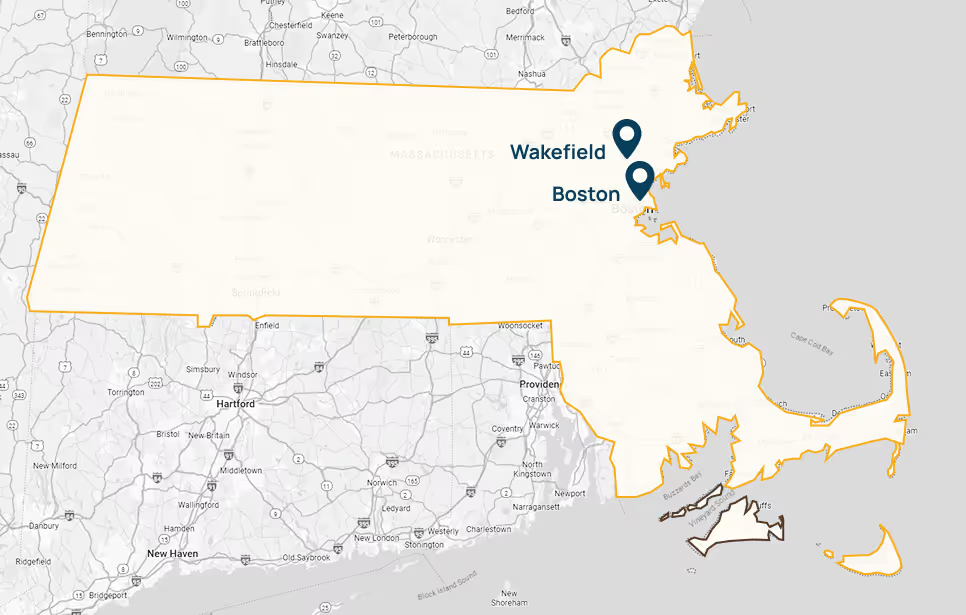
If you or a loved one was hurt in a Boston excavator accident, trench collapse, or any other excavation accident in Massachusetts, Attorney John J. Sheehan is ready to help. He has been fighting for injured workers throughout Massachusetts since 1993. We work on a contingency fee basis, so you pay nothing unless we win compensation for you.
Types of Excavation and Trench Accidents We Handle
Excavation and digging accidents on Boston construction sites take many forms. The Law Office of John J. Sheehan handles the full range of these dangerous work incidents, including:
- Trench collapses and cave-ins: The sudden failure of an unprotected or inadequately shored trench wall, burying workers under thousands of pounds of soil.
- Excavator and heavy equipment accidents: Struck-by incidents involving excavators, backhoes, bulldozers, and other heavy machinery operating near workers on foot.
- Falls into open excavations: Workers or bystanders who fall into improperly marked or unguarded excavation sites.
- Toxic fume and oxygen-deficiency incidents: Hazardous fumes, low oxygen levels, or gas line ruptures in confined excavation spaces.
- Electrocutions from underground utilities: Contact with unmarked or inadequately protected underground utilities, including power lines, gas lines, and water mains.
- Flooding and drowning in trenches: Water accumulation from rain, burst pipes, or groundwater in unprotected excavations.
- Defective equipment failures: Malfunctioning shoring systems, faulty trench boxes, or defective heavy machinery that creates dangerous conditions.
- Scaffolding and ladder accidents adjacent to excavations: Falls from elevated work areas positioned near open trenches.
Every one of these scenarios can produce severe injuries — or worse. If you were hurt or if a loved one was killed in any of these circumstances, you may have significant legal rights under Massachusetts law.
Injuries Common in Boston Excavation and Trench Accidents
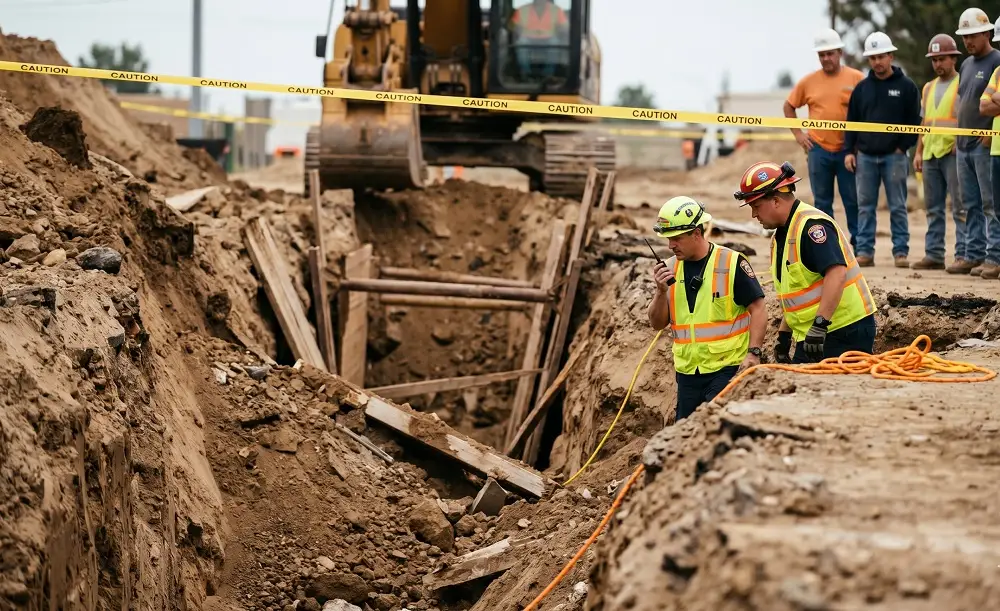
Excavation and trench accidents inflict some of the most severe injuries seen in construction work. When tons of soil collapse or heavy equipment strikes a worker, the results can be permanent and life-altering.
Workers and accident victims commonly suffer injuries, including:
- Traumatic brain injuries (TBI): Caused by crushing impact, oxygen deprivation, or blunt force, TBIs can impair memory, cognition, and daily functioning for life.
- Spinal cord injuries: Compression or severance of the spinal cord from a cave-in or heavy equipment accident can result in partial or complete paralysis.
- Crushing injuries: The immense force of soil collapse or heavy machinery contact destroys muscle, tissue, and bone, sometimes requiring amputation.
- Broken bones: Fractures to the arms, legs, ribs, and pelvis are common when workers are struck by soil or equipment.
- Respiratory damage: Exposure to hazardous fumes or oxygen depletion in a trench can cause lasting lung injury and respiratory problems.
- Organ damage: Internal injuries from crushing forces can damage the liver, kidneys, and other vital organs, often requiring emergency surgery.
- Asphyxiation and brain damage: Workers trapped under soil or exposed to toxic fumes can suffer brain damage from oxygen deprivation within minutes.
- Electrical burns and electrocution injuries: Contact with underground power lines or improperly grounded electrical equipment can cause severe burn injuries and cardiac events.
- Wrongful death: Trench and excavation accidents are among the deadliest in construction. Many accidents claim the lives of workers who leave behind families with no income and no answers.
These catastrophic injuries frequently mean months of recovery, multiple surgeries, permanent disability, and the loss of the ability to return to construction work. The medical bills alone can be overwhelming. And this is before you even account for lost wages and the financial impact on your family.
Speak with Attorney Sheehan Today — Free Consultation
You have nothing to lose and everything to gain by calling. Attorney Sheehan will review your case at no cost and explain your options in plain language, in either English or Spanish.

How Boston Workers Get Injured While Excavating, Digging, or Trenching
When digging trenches deeper than five feet, workers must institute safety measures. This pertains not only to the Boston, Mass. area, but throughout the nation. Occupational Safety and Health Administration publishes documents outline what type of systems must be used based on the depth of the trench. Safety systems include:
Workers excavate the sides of the trench, forming horizontal steps or levels. The surfaces between the steps are usually near-vertical or vertical. This method cannot be used in Type C soil, the most unstable type commonly encountered in the Greater Boston area, where clay-heavy, water-saturated ground conditions are frequent.
If workers use sloping as a protective measure, they cut the trench wall at an angle. The top of the trench is wider than the bottom. Proper slope ratios depend on soil classification. This determination must be made by a competent person before work begins. Cutting corners on this assessment is one of the most common causes of fatal trench collapses.
Workers install supports that keep the soil from caving in. Support systems may be aluminum, hydraulic, or other types as required by OSHA standards. Shoring systems must be designed to handle the specific soil and load conditions present, as a failure to do so is a serious safety violation.
Trench boxes prevent the trench from caving in on workers. While this shielding protects workers within, the boxes must still be properly positioned, maintained, and matched to the depth and soil conditions of the specific excavation.
When a contractor designs protective systems, they must take into consideration several factors, including the type of soil, the depth of the trench, the amount of water in the soil, and other factors.
What Causes Trench Collapses and Excavation Accidents in Boston
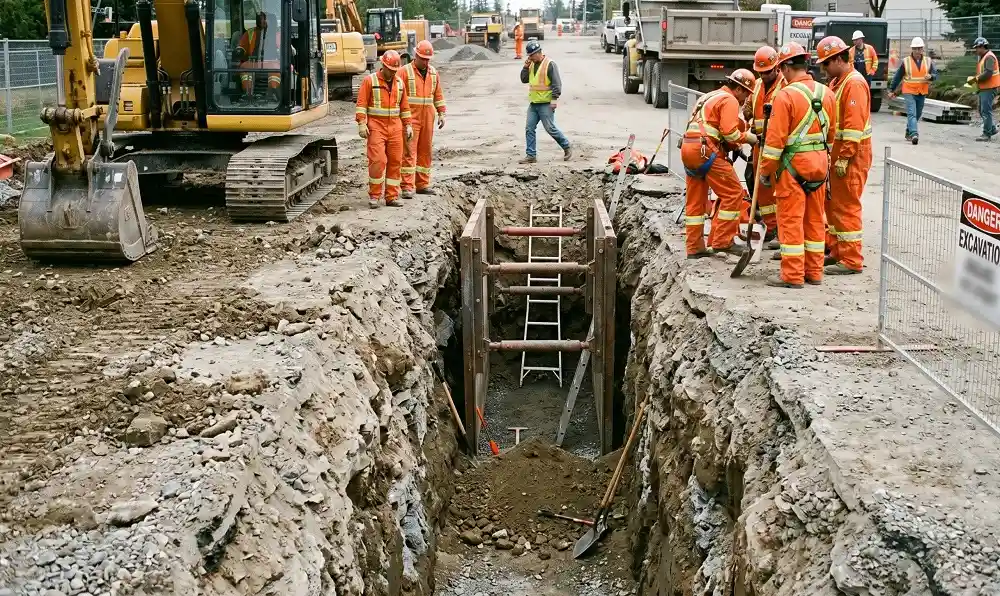
Most excavation accidents and trench collapses in Boston are preventable. They happen because contractors, property owners, or equipment manufacturers cut corners, ignore safety measures, or fail to follow Occupational Safety and Health Administration requirements.
Common causes our team investigates include:
- Failure to implement a required protective system: No sloping, shoring, or trench box in place for a trench exceeding five feet.
- Failure to test soil conditions: A competent person must classify the soil before excavation begins. Skipping this step is a direct OSHA violation.
- Ignoring underground utilities: Contractors must contact utility companies to locate underground utilities before digging. Striking a gas or electric line can cause explosions and electrocution.
- Improperly moving excavated soil: Piling excavated dirt too close to the trench wall creates surcharge loads that can cause the trench wall to collapse without warning.
- Failure to account for traffic patterns: Vibration from vehicles and heavy equipment on nearby roads destabilizes trench walls, especially in Boston's dense urban environment.
- Failure to inspect after weather events: Rain saturates the soil, dramatically increasing the risk of collapse. Trench inspections must occur at the start of every shift and after any rain or disruptive event.
- Defective equipment: Malfunctioning excavators, broken trench boxes, or faulty shoring components cause accidents even when other precautions are in place.
- Inadequate training and supervision: Workers sent into trenches without proper training, in a language they understand, cannot protect themselves from hazards they were never taught to identify.
This last point matters deeply for Boston's construction workforce. Latino construction workers represent approximately one-third of the national construction workforce but suffer 41.6% higher workplace fatality rates. Language barriers, such as when Spanish-speaking workers receive safety instructions only in English, significantly compound the danger.
Who Can Be Held Responsible for a Boston Excavation or Trench Accident
Identifying every negligent party is one of the most important things an experienced trench collapse lawyer can do for an injured worker or their family. Multiple parties may be held liable, and pursuing all of them can make a significant difference in the compensation your family receives.
General Contractors
General contractors bear overall responsibility for safety on Boston construction sites. When they fail to enforce OSHA standards, allow excavations to proceed without required protective systems, ignore dangerous conditions reported by workers, or rush timelines in ways that compromise safety, they can be held responsible for resulting injuries.
Property Owners and Developers
Property owners and developers who control the work site, set the schedule, or approve cost-cutting measures that compromise safety may face liability under Massachusetts premises liability law. Demanding unrealistic timelines that push contractors to skip safety steps is a form of negligence.
Subcontractors
When one subcontractor's unsafe excavation practices endanger workers from another trade, that subcontractor may be held liable for the resulting injuries. Excavation, demolition, and utility contractors whose work creates dangerous trench conditions are frequently among the negligent parties in these cases.
Equipment Manufacturers
Defective equipment, including faulty trench boxes, malfunctioning hydraulic shoring systems, and heavy machinery with design flaws, can make an otherwise properly managed excavation site deadly. Massachusetts imposes strict liability on manufacturers whose defective products injure workers. You do not need to prove negligence, but only that the equipment was defective when it left the factory.
Utility Companies
Utility companies that fail to accurately mark underground utilities before excavation begins can be held liable when unmarked power lines, gas lines, or water mains cause explosions, electrocutions, or flooding.
Your Legal Rights After a Boston Excavation or Trench Accident
Massachusetts law provides injured construction workers and their families with multiple paths to compensation. Understanding the difference between these options and pursuing all available avenues is critical to maximizing your recovery.
Workers' Compensation Benefits
Massachusetts workers' compensation provides immediate benefits regardless of fault, including all reasonable medical treatment and wage replacement at up to 60% of your average weekly wage. Undocumented workers have identical rights. Your immigration status is entirely irrelevant under Massachusetts law.
Third-Party Personal Injury Claims
Workers' compensation covers only a fraction of what you may truly deserve. When a party other than your direct employer contributed to your accident, you may file a separate personal injury lawsuit to recover 100% of lost wages, complete pain and suffering damages, and full lifetime medical costs.
Statute of Limitations
Under Massachusetts law, you have three years from the date of your injury to file a personal injury lawsuit. Workers' compensation claims have a four-year deadline. Evidence disappears quickly, so the sooner you contact an experienced trench collapse attorney, the stronger your case will be.
Get Your Free Case Review
Injured in a trench or excavation accident? Attorney Sheehan will review your case at no cost — in English or Spanish.